Side Loader Forklifts for Long Loads
A side loader enquiry starts with the complete long load and storage route. Share length, section, weight distribution, aisle, rack, surface and destination so a documented catalogue option can be reviewed.
Discuss this equipment ↗Describe the long load as a complete package
Record the full length, width or section, total weight and weight distribution of the material. Explain whether it is bundled, flexible, fragile or difficult to support. A long load can behave differently from a pallet with the same weight, so send a drawing or photographs when its geometry is important to safe pickup and placement.
Describe the material as it will actually be handled, including packaging, supports and any overhang. Identify the pickup and final storage position. These inputs help define the enquiry without assuming that every item described as timber, pipe or profile can use the same platform, forks or support arrangement.
Catalogue options to discuss
- 3 t electric side loader catalogue option
- 3 / 6 t diesel side loader catalogue options
- 10 t diesel side loader enquiry
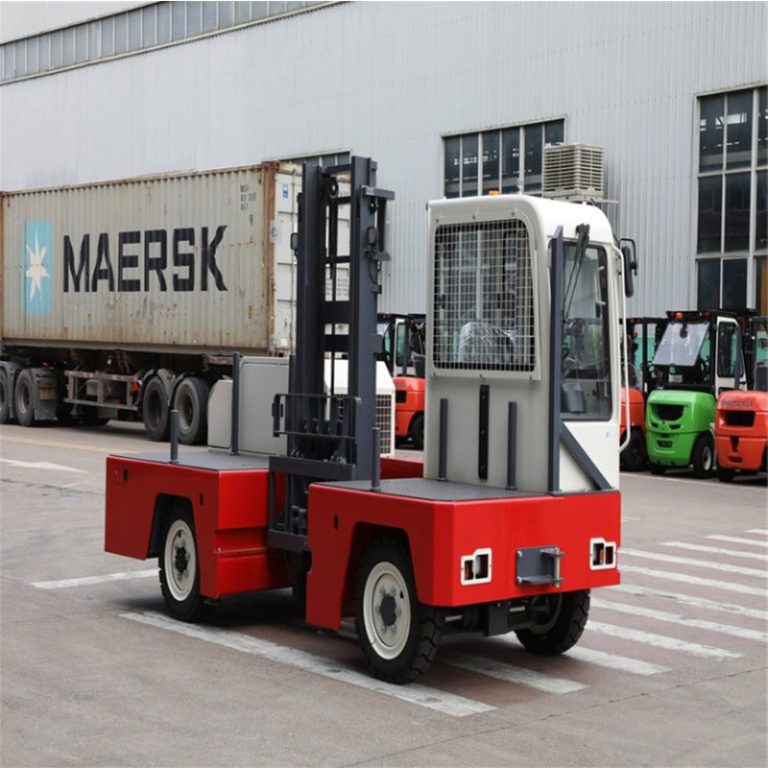
Map the aisle and storage arrangement
Measure the narrowest aisle, turning area, doorway and route between pickup and storage. Include rack openings, support heights and clearance around nearby structures. If the layout changes along the route, show the tightest point rather than an average aisle width. A simple marked plan can make the discussion much clearer.
A side loader may be considered when carrying a long load lengthwise changes the required aisle compared with a conventional front-loading route. That does not prove suitability for every narrow aisle or load. Ask for the proposed truck dimensions and working information, then compare them with the real storage layout and the buyer’s site controls.
- Material length and section size
- Weight and load distribution
- Aisle width and storage arrangement
- Travel surface and required lift
Review the documented catalogue options
The verified source supports a 3 tonne electric side-loader reference, 3 and 6 tonne diesel side-loader references, and a separate 10 tonne diesel side-loader enquiry. These are catalogue options for discussion, not a continuous capacity range and not a statement of current stock.
Keep the electric and diesel options separate when comparing power, duty and operating environment. Do not treat a multidirectional truck as an automatic synonym or available substitute; the source does not verify such a product. The exact model, dimensions, support arrangement, engine or battery and included equipment must be named in the quotation.
Check surface, travel and load support
Describe the floor or yard, gradients, thresholds, travel distance and expected daily hours. State whether the truck moves indoors, outdoors or between both. Add the required lift and lowest overhead restriction. The buyer must assess the route, pedestrians, storage system, operators and applicable local rules for the actual workplace.
Explain how the material should be supported during pickup, travel and set-down. Request confirmation for the proposed fork, platform or support arrangement and for the load position used in capacity information. Similar nominal capacities do not establish that two trucks handle the same material geometry or work in the same aisle.
- Material length and section size
- Weight and load distribution
- Aisle width and storage arrangement
- Travel surface and required lift
Prepare the side-loader quotation request
Send a material drawing or clear dimensions, total weight and distribution, pickup and storage positions, aisle and rack measurements, lift, clearance, surface, duty cycle, quantity and destination. List the technical and shipping documents required before the purchase decision. Mark unknown measurements for follow-up rather than guessing.
The offer should identify the proposed model, power source, rated information, dimensions, load support, documents, current availability, packing, shipping scope and commercial terms. JinChengYu does not claim that every catalogue option is in stock, that a multidirectional alternative is available, or that one configuration suits every long-load site.
Questions before you enquire
Which long-load dimensions belong in the enquiry?
Send the full length, section, weight, distribution, packaging and support points, plus the pickup, route and final storage position.
Is a side loader the same as a multidirectional forklift?
Do not assume so. This source supports side-loader catalogue options only. Request the exact proposed machine and its steering and operating information.
Which site measurements matter most?
Include the narrowest aisle and doorway, turning area, rack opening, support height, lift, overhead clearance, gradients and surface.
General safety references
These independent sources support the application and workplace questions on this page. They do not certify a product or replace the exact model manual, local rules or a site-specific assessment.