Diesel Forklift Trucks
A diesel forklift enquiry should connect the load and mast to the route, surface, duty cycle and destination. JinChengYu can discuss documented catalogue groups after those application details are clear.
Discuss this equipment ↗Define the outdoor handling job
Begin with the heaviest regular load, its dimensions and load centre if known. Record the highest placement point, the lowest mast clearance and any attachment. Then map the travel route, including gradients, thresholds, turning space and the surface under the truck. These details matter more than selecting a capacity label from a photograph.
State how many hours the truck normally works and where the busiest periods occur. Explain whether any part of the route enters a building or another restricted area. A diesel category name is not proof that a proposed truck is suitable for every workplace. The buyer must assess ventilation, traffic controls, operating practice and local rules for the actual site.
Catalogue options to discuss
- FD15-X30 / FD18-X30 / FD20-X24
- FD25-X24 / FD30-X24 / FD35-X24
- T2 and G series enquiries
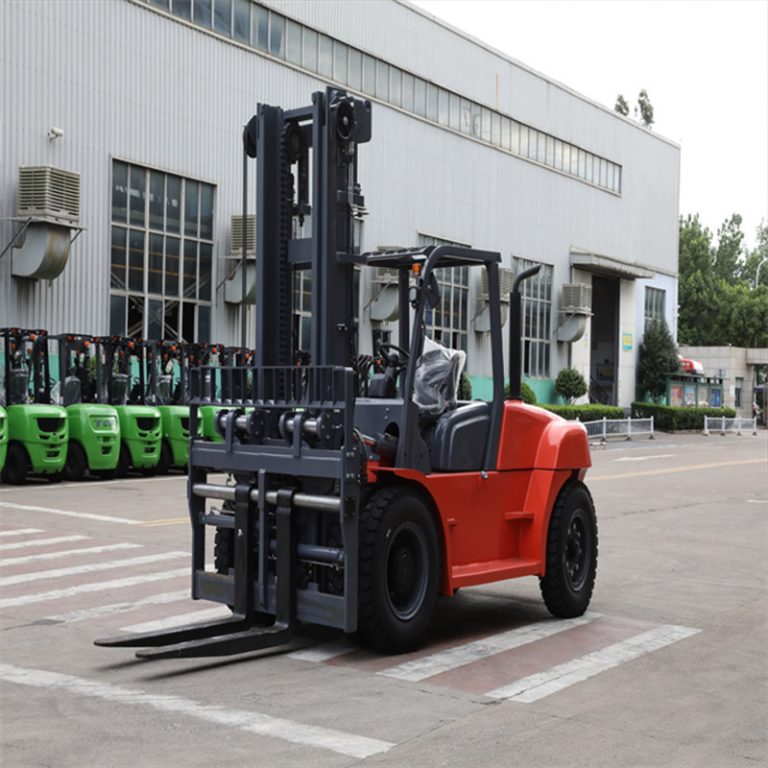
Use catalogue groups without extending their facts
The verified material includes 1.5, 1.8, 2, 2.5, 3 and 3.5 tonne catalogue groups with FD15-X30, FD18-X30, FD20-X24, FD25-X24, FD30-X24 and FD35-X24 references. It also records separate 3 and 3.5 tonne T2 groups, 4 to 5 tonne groups, selected G-series groups and individually documented heavy-capacity catalogue ranges.
Those references organize an enquiry; they do not establish that every intermediate capacity or configuration is available. Do not extend T2 or G-series statements beyond the documented group. A reach stacker belongs to its own equipment category and must not be presented as a telehandler or a standard diesel forklift. Ask the quotation to identify the exact model and current model sheet.
- Load weight and load centre
- Required lift and lowered mast height
- Ground conditions and operating hours
- Destination and engine documentation
Check mast, load centre and attachment
Rated capacity, load centre and required lift height belong in the same review. Keep lift height separate from lowered mast height, which determines whether the truck can pass beneath a restriction. A sideshift, clamp or another attachment can move the effective load centre and change the usable capacity, so identify it before a machine is proposed.
Request the capacity information for the proposed truck, mast and attachment combination. Include load shape and pallet entry, not only weight. If the load is long or handled in narrow storage, compare the side-loader route separately. A family name cannot replace a model-specific check of capacity, dimensions and the working path.
Identify engine and destination documents
Name the delivery country or port early and list the engine or import documents that need review. Website copy and certificate images do not prove that every engine configuration meets every destination rule. Ask for the engine identification and supporting documents associated with the exact machine offered, then arrange the buyer’s own destination review before ordering.
The linked HSE lift-truck guidance is general workplace safety reading. It does not certify a JinChengYu configuration or replace the model instructions, operator training, site assessment and local law. JinChengYu does not apply one emissions, fuel-saving, warranty, lead-time or compliance statement across the diesel category.
- Load weight and load centre
- Required lift and lowered mast height
- Ground conditions and operating hours
- Destination and engine documentation
Prepare a comparable diesel forklift quotation
Send load weight and dimensions, load centre, lift and clearance measurements, attachment, route, gradients, surface, daily use, quantity and destination. State which engine and shipping documents are required. If a measurement or rule is still being checked, mark it as pending rather than inserting an assumed value.
The written offer should confirm model, rated information, mast, attachment, engine, tyres, dimensions, documents, current availability, packing, shipping scope and commercial terms. Compare offers against that same application brief. This page is an enquiry route and does not claim live stock, universal destination approval or one commercial package for every truck.
Questions before you enquire
Which diesel forklift details should I send first?
Send the load and load centre, lift height, lowered mast limit, attachment, route, surface, duty cycle, quantity, destination and required engine documents.
Are all capacities between the listed catalogue groups available?
No such conclusion is made. Use only the documented groups as enquiry references and request the exact current model and configuration in writing.
Does a website category prove destination compliance?
No. Ask for the engine identity and documents for the exact offered machine, then complete the destination-specific review before ordering.
General safety references
These independent sources support the application and workplace questions on this page. They do not certify a product or replace the exact model manual, local rules or a site-specific assessment.